
Amazonius Germani Breeding Report (031026-070826)

This was the first breeding project of 2026. This female moulted in late December 2025. After this moult, my female measured roughly 5.5”. My female certainly lives up to the common name “Orange Tree Spider”, she is a fiery orange, with a slight green tinge to her carapace. She also has a fiery attitude. She is one of the only tarantulas in my collection who will bolt towards me out of her enclosure, and she slaps more than my Pokies! In contrast to the brilliant orange of the females, the males of these species turn smoky grey upon maturity. Although, they keep their orange feet and attitude.

Female after preconditioning
My female was kept at room temperature, around 70F or 21c. Other than increasing humidity and daily feeding, there was no other preconditioning for the female.
I found an available mature male in February and had the first pairing on March 10 2026. When introduced, the male immediately shook. He would take one or two steps, shake, and wait for the response. My female was very receptive at this time. She tapped back to him after each buzz, and gradually came towards him. This male was very nervous, and led her around the enclosure for 25 minutes with no attempts at insertion. At two points, the female even reared up in a display that could be mistaken for a threat-pose. However, that is a natural, receptive mating behaviour for this species. Insertion usually happens quickly for this species so I decided to remove the male after 30 minutes.
On March 13, I reintroduced the male. Normally, a male will buzz and tap, leading the female into a perfect position for pairing. For arboreal species, the male typically wants the higher ground. This makes it harder for the female to grab him, and easier for him to bolt away after insertion. The male was initially leading the female around the enclosure like the initial pairing. Then, he decided to go down to the ground, with the female following close behind. At this point, I was no longer in a position to intervene. If she attacked him, all I could do at this angle would be to push her closer to him. Unfortunately, backed into a corner he attempted insertion, and my female was able to grab and eat him as he had no escape. This was extremely disappointing as without proper insertion, him being my sole male stalled my breeding project.
Fortunately, I was able to find a fellow breeder in B.C. who had two freshly matured males. After some coordination, I received both males on April 15, a month after the last breeding attempt. Normally, I prefer to let males decompress before mating as a stressed male is not likely to pair. However, one male in particular was extremely active inside his shipping container so I decided to test the waters. Immediately, he shook and my female came up to him. Insertion happened extremely quickly after only 10 minutes of courtship, and lasted 20 seconds. I did not get any footage of this pairing. I was being extra cautious after the last pairing attempt, and wanted to focus on the spider’s safety. The male bolted after insertion, and was placed into his prepared enclosure.
After pairing, the female was fed 1-2 large crickets daily until she stopped eating around May 10. At this point, I candled her and confirmed she was gravid.
Gravid Female Pictured Above
10 days later, the morning of May 20, the female began creating her egg sac. She tended to her sac until June 5. She began to sporadically leave the egg-sac unattended for stretches of 15-30 minutes. As this is atypical, I removed the sac at day 20, on June 10, 5 days before I originally planned to. It seems like a short time period, but development is rapid for this species. A day can mean the difference between life stages for developing eggs.
I was shocked when I opened the sac to find “eggs with legs”, or EWL inside. And a lot of them too! There were a few eggs clumped together as a result of the mother not turning the sac towards the end. Another key reason it is important to remove an egg-sac if the mother is not tending it.

After separating, there were 209 EWL, 38 fertile eggs, and only 3 bad eggs. Approximately 13 eggs were crushed during the separation process of the badly clumped eggs. This means a total of 263 eggs in this sac.
The eggs were placed into a rudimentary incubator, and incubated at 80%+ humidity and kept at a temperature of 85-90F or 29.5-32c with a slight dip in temperature overnight. 5 days later on June 15, the eggs with legs moulted into first instar (1i) nymphs.
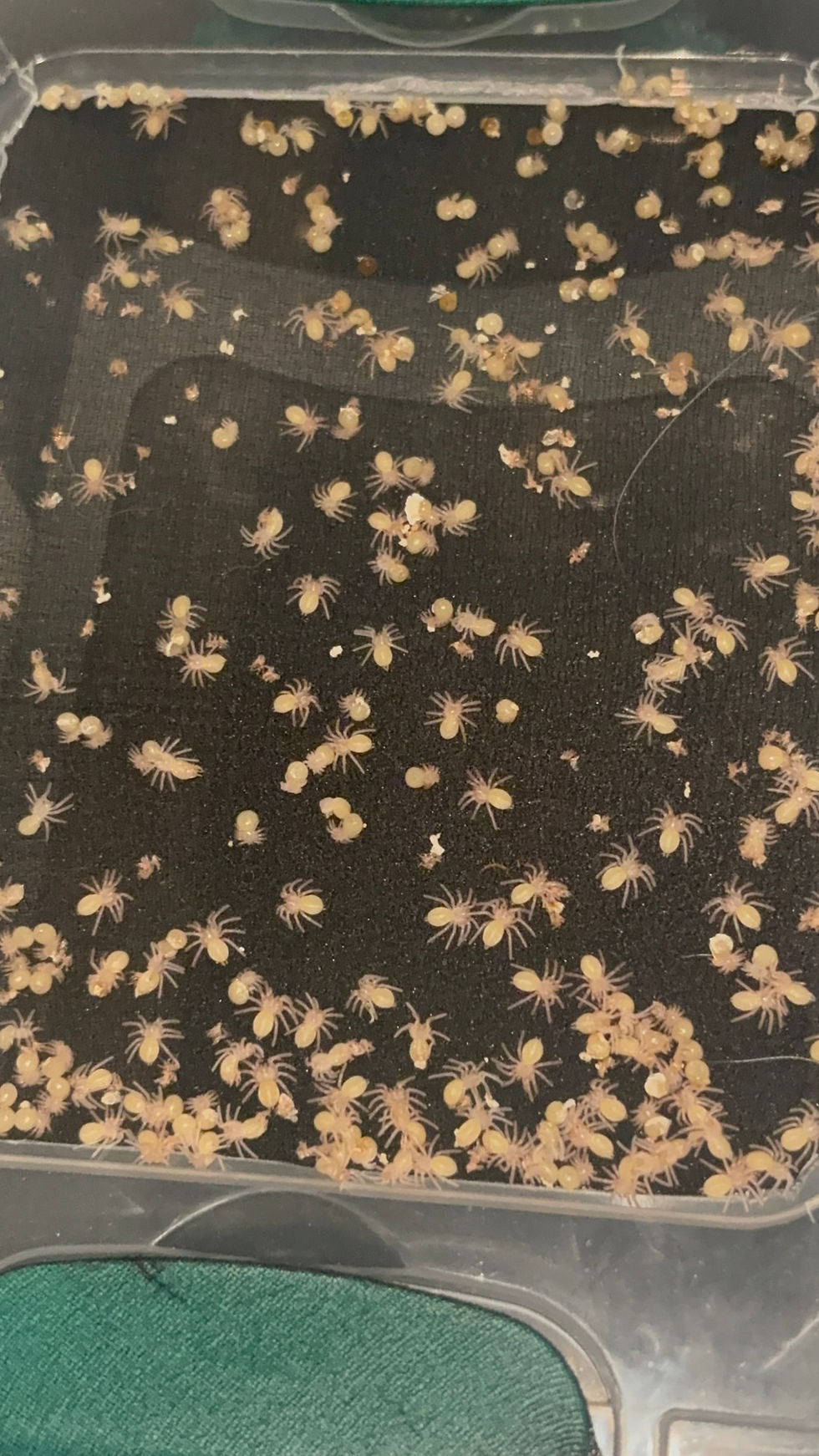
Nymph Alert!
At this point, there were a few eggs that had started to go bad. These were removed as 1i nymphs can be sensitive to moulds and fungus. Even though they have limited mobility, the nymphs were quite active, probably due to the higher temperatures. Higher temperatures increases development speed, and soon the nymphs were turning dark and getting ready to moult again. The abdominal patterns of the new exoskeleton became visible a few days prior to moulting.

A mix of second instars (2i) and darkened 1i nymphs showing abdominal patterns.
On July 7, the nymphs began to moult into second instar slings. The 2i slings have distinctive yellow striped abdomen’s, black carapaces, and pink legs with black boots. Slings keep this coloration until they become juveniles and begin sport vibrant orange colours. Males and females have the same colouration until they reach maturity.

Slings after majority have moulted.
Amazonius germani is a species that can double clutch, meaning she can have another egg-sac before her next moult cycle. I will reintroduce the males after following the same preconditioning process as before. If successful, the next clutch should have slings available for purchase.
Thank you for reading!
Comments